What actually compounds demand for suburbs with downtowns, and what quietly stalls out.
Suburbs with “downtowns” are everywhere now. They're table stakes for a good investment in a home or condo and are no longer a guarantee of future value.
The suburbs that continue to appreciate, the ones that stay liquid and attract new buyers across cycles tend to share a set of structural traits. Those traits show up in pricing because they show up in daily behavior rather than "event-centric" experiences.
This isn’t about charm or aesthetics (although you have to have that too). It’s about whether a place works as everyday infrastructure for the people who live there.
---
Walkability creates premiums, but only when it changes routine
There’s broad agreement in urban economics that walkable, mixed-use places command higher values. But the key nuance is this:
Walkability inside a project is not the same as walkability as a pattern.
Places that compound are the ones where walking isn’t a feature for getting between restaurants, it’s also how errands and social life overlap.
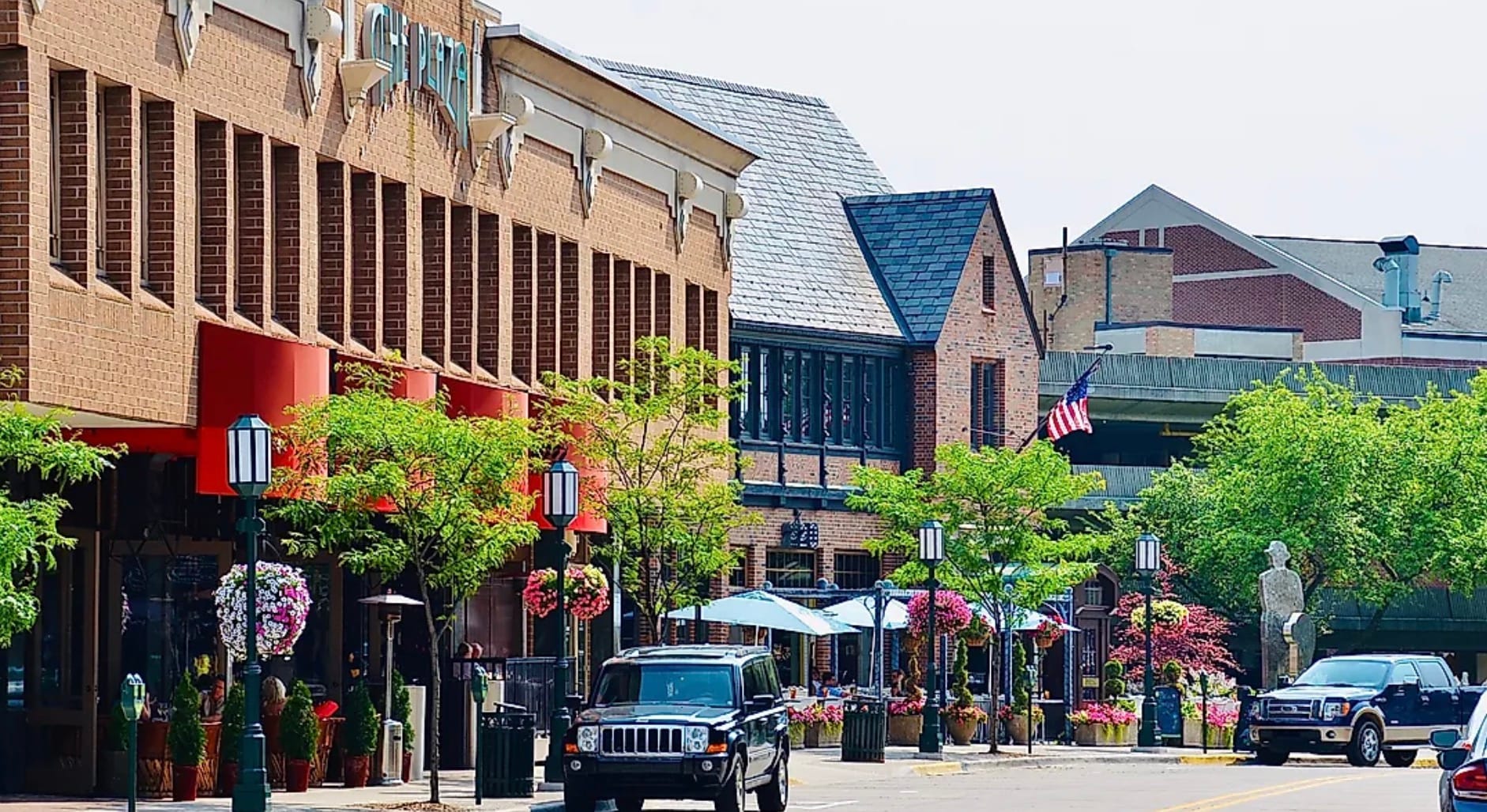
That’s why places like Birmingham, Michigan continue to command some of the highest prices in the Midwest, and the highest in Michigan. Downtown Birmingham isn’t just a destination. It’s the default setting for daily life of the people who live near there. People pass through without planning. That’s what demand looks like when it’s structural.
---
Signal 1: A connected street network, not pods and arterials
Why it matters economically:
Connected streets allow multiple routes, support foot traffic, and enable incremental infill over time. Pod-and-arterial layouts concentrate traffic, isolate neighborhoods, and cap the upside of “walkable” cores. Pod-and-arterial layouts are places where neighborhoods, shopping areas, and offices are separated into pockets and connected mainly by big, fast roads. You can usually get to the downtown, but only by driving through traffic, and there’s often no easy or pleasant way to walk there from nearby homes. Birmingham is missing a grocery store in the true "downtown" area, it's very walkable, but instead it has them across the major thoroughfare of Woodward Avenue. It's one of the only slight weaknesses of the city center.
What this looks like when it works:
In Evanston IL, a suburb of Chicago, neighborhoods flow naturally into downtown. Transit stops, schools, retail, and housing overlap. That connectivity is a big reason Evanston remains resilient despite market cycles.
What stalls out:
A single mixed-use node surrounded by cul-de-sacs and wide arterials.
---
Signal 2: Daily needs within walking distance, not just restaurants
Restaurants create weekends. Errands create routines.
Why it matters economically:
Value follows repetition. Downtowns that support daily tasks generate consistent foot traffic, which stabilizes retail, services, and housing demand.
Where this is visible:
In Brookline MA, a suburb of Boston, groceries, schools, transit, and services sit close enough that walking is normal, not aspirational. That’s one reason Brookline holds premiums even as nearby areas build newer stock.
---
Signal 3: Housing on top of downtown, not just near it
Why it matters economically:
Downtowns need residents at different price points to stay alive across the day and week. When housing is pushed too far out, activity becomes episodic.
Where it compounds:
Places like Palo Alto, which is kind of a suburb of both San Francisco and San Jose, succeed not because they’re exciting, but because people live close enough to use downtown casually. That predictability is a demand stabilizer.
---
Signal 4: Parking is managed, not dominant
Surface parking is a hidden value killer.
Why it matters economically:
Parking-heavy cores limit tax productivity and block future infill. Managed parking preserves land for uses that generate activity and revenue.
Pattern match:
High-performing suburbs almost always hide parking behind buildings or underground or share it across uses. Where parking dominates the frontage, appreciation tends to plateau.
---
Signal 5: A civic anchor that brings people out on weekdays
Retail follows foot traffic. Foot traffic often starts with institutions.
Why it matters economically:
Libraries, schools, civic buildings, and community centers create weekday activity that retail alone can’t.
Where this shows up:
In Berkeley, a city-ish suburb of Oakland and San Francisco, civic and educational anchors overlap with retail and housing. That overlap is a major reason the city remains socially and economically durable.
---
Signal 6: Active place management (with real authority)
Why it matters economically:
Places that compound are curated over time. Cleanliness, tenant mix, programming, and conflict management don’t happen by accident.
Pattern to watch:
If a downtown has a funded BID (Business investment district) or equivalent, it’s a strong positive signal. If everything depends on the original developer or city hall enthusiasm, risk goes up.
---
Signal 7: “Bones”, or the ability to evolve over time
Why it matters economically:
Downtowns built all at once tend to age as a single idea. Places made up of smaller parcels and multiple owners can change one piece at a time, which makes them more resilient and better at holding value.
What this looks like when it works:
In Birmingham, small lots, mixed ownership, and buildings from different eras allow businesses and uses to evolve without disrupting the whole downtown.
Red flag:
A downtown that feels finished, branded, and controlled by one developer often struggles to adapt as markets and tastes change.
---
Signal 8: Visible, unscheduled social life
Culture isn’t the same as programming. A suburban downtown that depends entirely on programming for social energy will struggle to drive fun organic vibes.
Why it matters economically:
When residents organize themselves, lingering without buying, recognizing each other, letting kids roam, tenure length increases and churn decreases.
That social stickiness is a quiet driver of value.
---
Signal 9: Fiscal productivity that supports reinvestment
What it means:
The downtown is built in a compact, mixed-use way that produces more tax revenue per acre than parking-heavy retail or single-use development.
Why it matters economically:
When a city generates steady revenue from its core, it can maintain streets, parks, and public spaces without relying on constant incentives or one-time projects. Places that can reinvest consistently tend to age better and hold value more reliably over time.
---
Signal 10: Embedded local employment + strong regional job access
What this means:
The suburb benefits from access to a large, diversified regional job market and includes a modest amount of office or institutional employment within the downtown itself.
Why it matters economically:
Local employment supports weekday foot traffic and business stability. Regional job access deepens the buyer pool and reduces household risk. Together, they create more durable demand.
What this looks like when it works:
- Offices above retail
- Professional services near housing
- Institutional anchors within walking distance
- No single-use office districts dominating the core
Red flags:
- Downtown with zero weekday population
- Office parks separated from the center
- Employment that overwhelms housing and civic uses
Why this matters for families (not just planners)
From a household perspective, this mix:
- Keeps restaurants and services open consistently
- Makes downtown feel alive on weekdays
- Reduces the risk that the “cute center” goes stale
- Supports resale demand across cycles
That’s why families are willing to pay premiums in these places — not because they’re trendy, but because they work.
The pattern that falls flat
If you see most of these together, proceed cautiously:
- One signature mixed-use project
- Restaurant-heavy, errand-light
- Surface parking everywhere
- No civic anchor
- No BID or durable governance
- No path for incremental infill
These places can be pleasant. They rarely compound.
Apply this framework to places you’re actually considering
If you’re comparing suburbs with downtowns in a specific metro, the hardest part is seeing past the marketing and understanding how these places really function day to day.
LookyLOO lets you search suburbs, save candidates, and compare them using the same signals in this guide, walkability that changes routine, housing mix, daily needs, civic anchors, and long-term adaptability.
Start a LookyLOO search ->
Related guides for comparing suburban downtowns
If you’re researching suburbs with downtowns, these guides are designed to work together — depending on where you are in the process.
- How to Evaluate a Suburban Downtown Before You Buy
A practical field guide for comparing places in person using observable cues. - What High-Performing Suburban Downtowns Have in Common
Examples from different regions that show what this pattern looks like in the real world.